
Announcements
Enter the fascinating universe of pulsars and magnetars, the most extreme stars in the cosmos! Space, that vast immensity that surrounds us, is full of mysteries and amazing phenomena that we are still trying to understand. Among the most intriguing and spectacular, we find pulsars and magnetars. These stars, far from being simple points of light in the sky, are true cosmic laboratories where extreme conditions occur.
Pulsars and magnetars are the remaining core of massive stars that have exploded in supernovae. They are incredibly dense and compact objects, with extraordinarily powerful magnetic fields. Understanding these phenomena will allow us to have a broader vision of how the fundamental forces of the universe work. And that is precisely what we will explore in depth.
In the following sections, we are going to unravel the secrets of these stars, discovering their origin, their structure and their behavior. We are going to talk about their unique properties, how they are formed and what we can learn from them. We will enter the exciting world of astrophysics, exploring the limits of our knowledge and embarking on a journey to the depths of the cosmos. Get ready for a fascinating journey through the mysteries of pulsars and magnetars, the most extreme stars in the universe!
Understanding Pulsars and Magnetars#
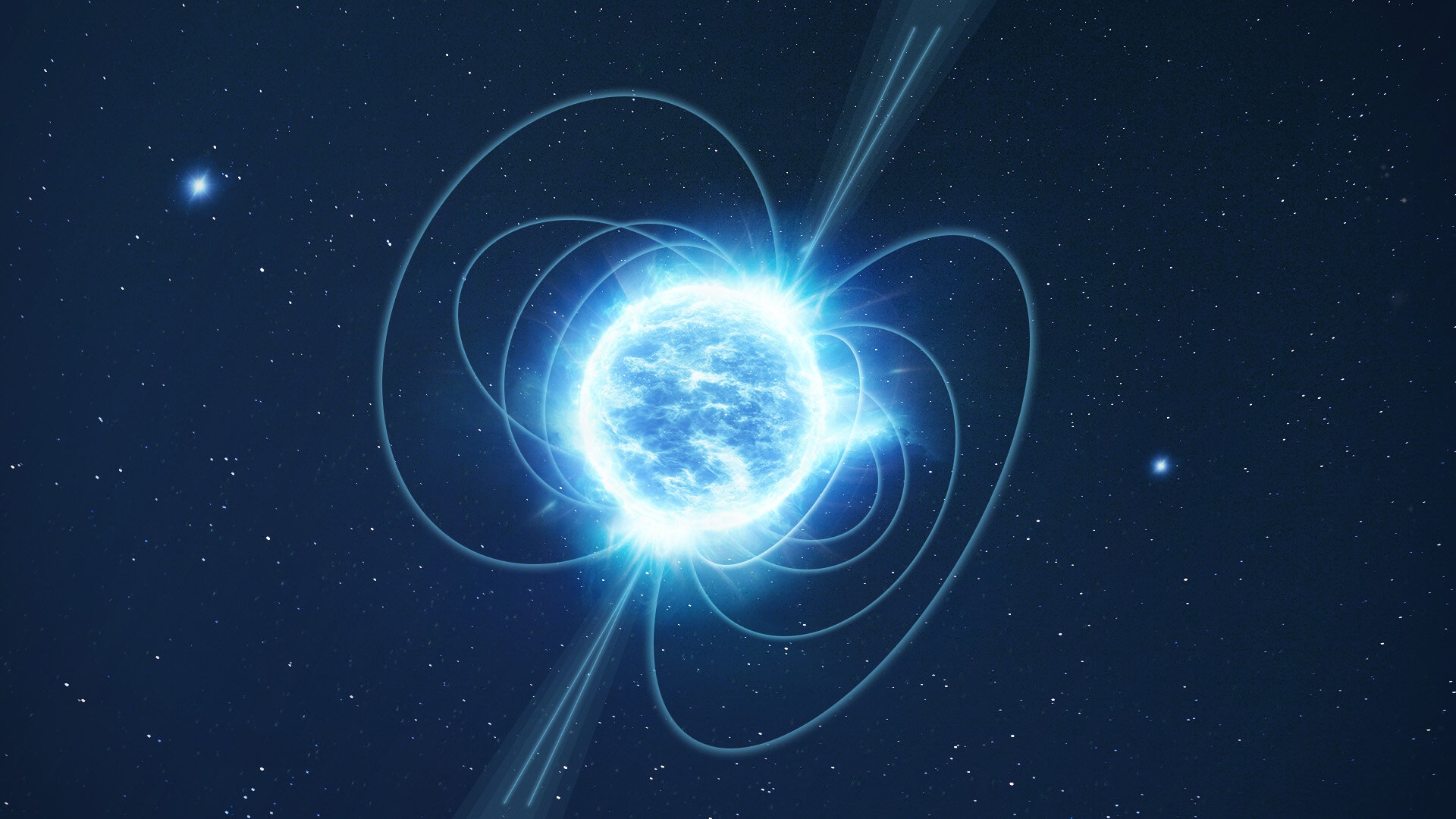
Pulsars and magnetars are two types of neutron stars, celestial bodies that, despite their small size, have an incredibly high density and are capable of emitting radio waves and X-rays with extreme magnetism power.
What are Pulsars?#
Pulsars are rapidly spinning neutron stars that emit beams of electromagnetic radiation. Discovered in 1967 by British astrophysicist Jocelyn Bell Burnell, pulsars have a strong magnetic field and emit pulses of radiation that can be captured here on Earth. The radio waves produced by a pulsar form a regular pattern, similar to the beat of a heart.
What are Magnetars?#
Magnetars, on the other hand, are the most extreme version of neutron stars. They have the strongest magnetic fields in the universe, up to a quatrilon (10^15) times stronger than that of Earth. Magnetars are believed to form from stars that have an already particularly strong magnetic field before collapsing in a supernova.
How Pulsars and Magnetars are Formed#
Formation of Pulsars#
Pulsars are the result of the death of massive stars, generally those with a mass between 1.4 and 3 times the mass of the Sun. When these stars exhaust their nuclear fuel, they collapse under their own weight and explode in a supernova. The remaining nucleus is so dense that protons and electrons combine to form neutrons, resulting in a neutron star.
Formation of Magnetars#
Magnetars form through a similar process, but are believed to come from stars with a very strong magnetic field before the supernova. After the explosion, the collapsed core inherits the original star's intense magnetic field, resulting in a magnetar.
Notable Characteristics of Pulsars and Magnetars#
Characteristics of Pulsars#
- Pulsars are extremely dense. A teaspoon of pulsar matter would weigh about a billion tons on Earth.
- They spin at incredible speed. Some can spin up to 700 times per second.
- The electromagnetic radiation emitted by pulsars is so regular that it can be used to measure time with a precision comparable to that of atomic clocks.
Characteristics of Magnetars#
- The magnetic field of magnetars is so powerful that it can influence the physics of matter over long distances.
- Magnetars are known to produce X-ray and gamma-ray bursts that can be detected throughout the galaxy.
- Although magnetars are relatively rare, they provide scientists with a unique opportunity to study extreme magnetic fields.
The Impact of Pulsars and Magnetars on Astrophysics#
Pulsars and magnetars have a significant impact on the field of astrophysics. The discovery of pulsars helped confirm the existence of neutron stars, which were previously just a theory. Furthermore, the regularity of a pulsar's pulses allows scientists to test Einstein's theory of general relativity.
Magnetars, with their extremely strong magnetic fields, provide a cosmic laboratory for the study of high-energy environments that cannot be replicated on Earth. Additionally, the X-ray and gamma-ray bursts they produce give astrophysicists unique glimpses of the distant universe.
In short, pulsars and magnetars are two of the most extreme and fascinating objects in the cosmos, the study of which continues to deepen our understanding of the universe and the laws of physics that govern it.
Conclusion#
In short, pulsars and magnetars are two of the most extreme and fascinating objects in the cosmos. Despite their small size, these neutron stars have an incredibly high density and are capable of emitting radio waves and X-rays with extremely high magnetic power. Pulsars, discovered by British astrophysicist Jocelyn Bell Burnell in 1967, rotate rapidly and emit pulses of radiation on a regular basis, similar to the beat of a heart. On the other hand, magnetars are the most extreme version of neutron stars, possessing the strongest magnetic fields in the universe. Pulsars and magnetars are notable for their extreme density, rapid rotation, and powerful radiation emission. Pulsars can even be used to measure time with a precision comparable to atomic clocks. Pulsars and magnetars have had a significant impact on the field of astrophysics. They have allowed scientists to confirm the existence of neutron stars and test Einstein's theory of general relativity. Magnetars, with their extremely strong magnetic fields, provide a cosmic laboratory for the study of high-energy environments that cannot be replicated on Earth. In conclusion, the study of pulsars and magnetars continues to expand our understanding of the universe and the laws of physics that govern it. They are, without a doubt, extreme stars of the cosmos that continue to reveal the mysteries of the universe. 🌌🔭🌠
Keep reading
You might also like

Exoplanets: Extraterrestrial Life in Sight
The search for extraterrestrial life has been one of humanity's greatest unknowns. In recent decades, with the advance...

Galactic Mysteries: Surprising Revelations
The universe, with its unfathomable mysteries, has fascinated humanity since time immemorial. Every star, every galaxy, every particle lost in...